Neutrinos: space particles that change our view of universe / Photo: Jonathan NACKSTRAND - AFP
Miniscule but packed with energy, neutrinos charge to Earth from outer space, bringing valuable data on the cosmos, according to research that won this year's Nobel physics prize.
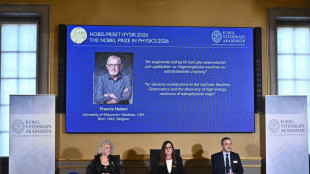
Here are facts about the subatomic particles observed by prizewinner Francis Halzen of Belgium, as told to AFP by members of his team and other scientists.
- What are neutrinos? -
With no electrical charge and virtually no mass, neutrinos scarcely interact with other matter and pass unseen through the galaxy and anything they touch -- even from one end of Earth to another.
"Every second, without you noticing, 65 billion neutrinos from the Sun flow through your little finger nail," said the Royal Swedish Academy of Sciences, in a statement presenting the prize.
"We use them like cosmic messengers," said Damien Dornic, a scientist at France's CNRS research institute.
They serve "to examine the core of astrophysical phenomena such as the hearts of stars, or even bigger ones such as the formation of black holes, the collisions of galaxies", he added.
- Antarctic ice observatory -
When a neutrino touches the nucleus of an atom, an electric charge is produced, giving off a blue light that can be observed in water or ice.
Halzen and his team installed the IceCube Neutrino Observatory -- nearly 5,500 optical sensors hundreds of metres under the Antarctic ice -- a dark place free of interference -- to observe the light from neutrinos passing through the Earth.
"What IceCube has done is to open a new window to observe the Universe," said Juan Antonio Aguilar, a professor at Brussels Free University and member of the IceCube collaboration.
"Like the first time a telescope was invented, but this time using these other elementary particles."
The site took seven years to build and has been collecting data since 2011.
"It's a completely different way of observing the Universe," said Paschal Coyle, a researcher at the Marseille Particle Physics Centre.
"You don't need to point a telescope at a specific place. We look in all directions, all the time."
The observatory has detected neutrinos with an energy charge about a thousand times that of the Large Hadron Collider, the world's biggest particle-accelerator.
When the sensors spot an interesting neutrino, a message is sent to other telescopes and sensors around the world, telling them to look in the same direction for further insight.
- Where do they come from? -
So-called high-energy neutrinos are thought to pass through the universe in straight lines from violent cosmic events such as exploding stars and the areas around black holes.
"We're starting to see what kinds of sources could emit these high energy neutrinos," said Erin O'Sullivan, astrophysicist at Uppsala University in Sweden and spokesperson for the IceCube collaboration.
"Our best guess right now is these active galactic nuclei, which are the really supermassive black holes with material around it."
Unravelling the mystery of the neutrinos' origin "could even solve other mysteries, such as the origin of so-called ultra-high-energy cosmic rays or even Dark Matter," said Philipp Eller of Munich Technical University, an IceCube analysis coordinator.
ber-fbr-pia-rlp/jll/ach
Y.Calvo--GBA