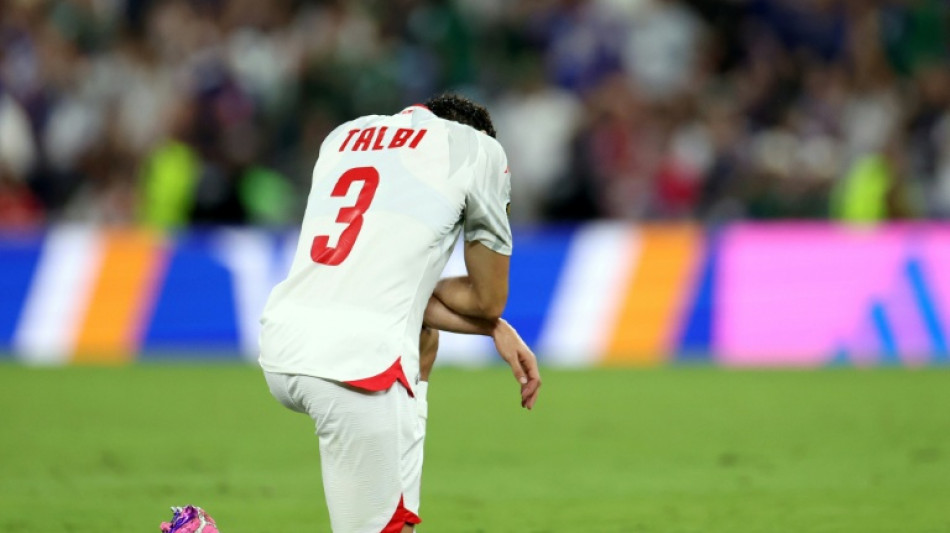
Tunisia's short-lived World Cup experience lays bare deep dysfunctions / Photo: Julio Cesar AGUILAR - AFP
Tunisia's humiliating exit from the 2026 World Cup after two heavy losses against Sweden and Japan delt a blow to Eagles of Carthage fans, who say it laid bare years of dysfunction within the football federation.
The team, which had made history in 1978 by becoming the first African nation to win a World Cup match, had hoped for a better tournament this summer.
But with nine goals conceded in two games and French head coach Sabri Lamouchi sacked after the first -- a 5-1 defeat to Sweden -- many Tunisians were faced with a different reality.
Beyond player performances, they blame a deeply flawed national sporting system.
"The collapse of the national team against Sweden and Japan has lifted the veil on the 'football mafia' whose dismantling everyone is demanding today, before starting from scratch and rebuilding our football," the Arabic-language daily AlChourouk wrote.
The French-language newspaper Le Temps argued that Tunisian football "has for many years been undermined by clientelism and inter-club infighting".
That has led to undeserving players being selected for the national team, the newspaper added.
Investigative outlet Inkyfada alleged that there was an "unofficial quota policy" that saw some local players called up only "to satisfy major clubs in the domestic league and ensure that each received their share of FIFA compensation".
The Tunisian football federation did not respond to AFP's requests for comment.
Things could get even worse for Tunisia's chastened players, whose last match on Thursday night is against Group F leaders the Netherlands, before they return home.
And back home, the World Cup has not generated great enthusiasm.
The team's early elimination, compounded by their matches kicking off in the middle of the night due to the time difference, many supporters have already felt disengaged.
"I had set my alarm, but at the last minute I changed my mind and went back to sleep," one coffee shop owner in Tunis told AFP following the Japan game.
Many have also recalled statements made by former Manchester United midfielder Hannibal Mejbri following Tunisia's elimination from the Africa Cup of Nations in January.
"We dream a lot, but we don't work enough," French-born Mejbri had said. "We really need to ask ourselves questions because we have fallen far behind."
Even if new head coach Herve Renard, who replaced compatriot Lamouchi shortly before Tunisia's 4-0 thumping by Japan, does find the answers on Thursday, his own long-term fate within the turbulent federation remains uncertain.
G.Molina--GBA