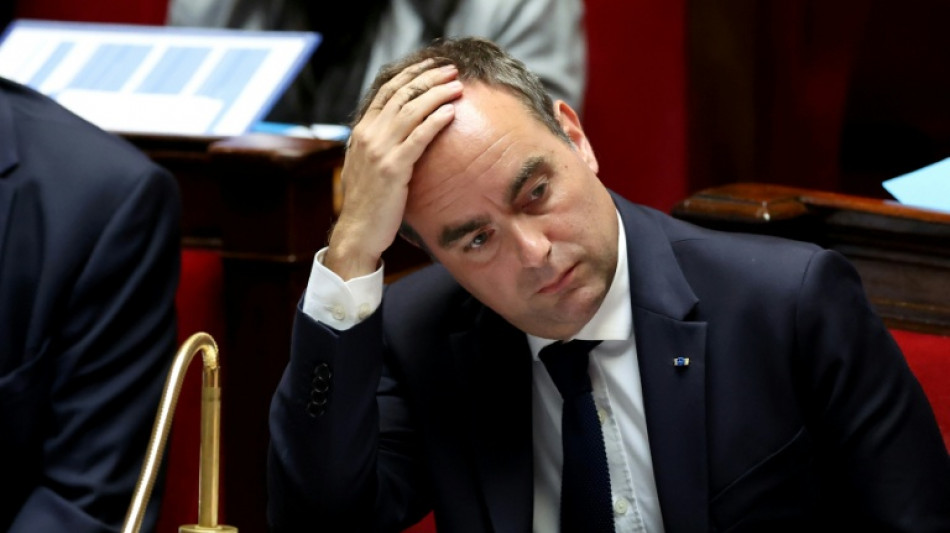
French economy minister denies country caught in debt 'snowball' / Photo: Xavier GALIANA - AFP
France's Economy Minister Roland Lescure said Tuesday that the country was not trapped in a debt "snowball" as he pressed opposition parties to pass a government budget for 2027.
President Emmanuel Macron's centrist government is anxious to pass a budget before the end of the year as it seeks to reassure markets that France can bring down its debt mountain.
Amidst political jostling ahead of a presidential election next year, opposition parties on the left and right oppose the government proposals, while there is mounting public anger over spending cuts.
Lescure told the lower house National Assembly that interest rates being paid for government bonds were worrying but insisted that France is not yet caught in a debt "snowball effect".
Launching a debate on the budget, he admitted that the bond rate had risen as high as 4.5 percent in recent days but said it should fall to an average 2.5 percent in 2027.
Lescure appealed for the adoption of a budget aiming for a five percent of GDP public deficit by 2027, through 43 billion euros ($48 billion) in spending cuts and other measures.
The debate started amid school protests over education conditions and political eyes turning to the presidential election next year when the far-right National Rally (RN) party hopes its candidate Marine Le Pen could win.
Opposition parties including the Socialists, who helped pass this year's budget, have slammed the government's planned measures that include reducing healthcare spending and capping pensions.
The Socialists planned to lay a motion against the budget which seemed doomed to fail through lack of support from key parties, including the RN.
- 'Confrontation' -
The RN has said it wants a full debate in parliament on the budget. Le Pen has said she would implement 140 billion euros ($157 billion) in cost savings by 2032 if elected next year. Her plan has been strongly attacked by other presidential candidates however.
Public Accounts Minister David Amiel warned that the French parliament could not afford to delay action on the budget, telling France 2 television that "interest rates are soaring today".
French government bonds have become the bane of investors amid fears that officials are unwilling or unable to rein in spending that far outstrips revenue.
Mounting concerns over France's finances have fund managers demanding higher returns for lending to France, resulting in a surge in costs that could spiral into a full-blown debt crisis.
"Financial markets need to feel that, whatever happens, we'll ultimately end up at five percent," a government source said.
Whether debate drags on for weeks or is cut short, the government has little prospect of securing passage of the budget through parliament under normal parliamentary procedures.
- 'More market pressure' -
The government wants to almost halve its social security deficit next year, bringing it down to 12 billion to 13 billion euros.
Among other measures, it is proposing that annual revaluations of pensions above 1,260 euros a month no longer be fully indexed to inflation.
The plan has drawn criticism spanning the hard left, far right and the conservative Republicans.
Lacking a parliamentary majority, the government could again use a constitutional power to ram the legislation through parliament without a vote, as it did last year.
Bruegel, a Brussels-based think tank, said the bond market had exposed a French economic problem that has been building for years.
"France may need to experience more market pressure before its political system is willing to accept reforms it has postponed for years," its analysts said. "Much greater stress may be what ultimately makes a broader governing agreement feasible."
A.Mendoza--GBA