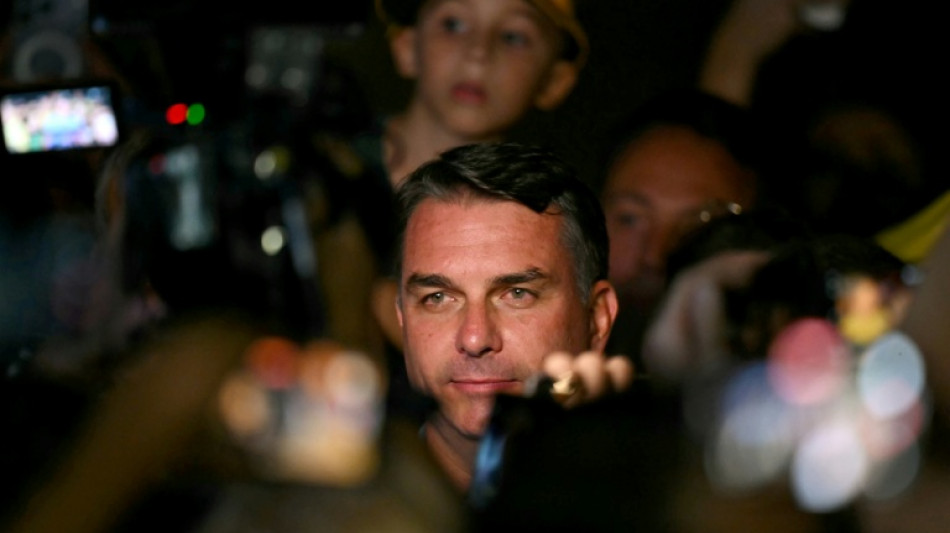
Bolsonaro rides right-wing surge into Brazil's election runoff / Photo: Evaristo SA - AFP
Right-wing Senator Flavio Bolsonaro heads to an October 25 runoff election from a position of strength, riding a conservative wave that has left President Luiz Inacio Lula da Silva facing a tough battle to win a fourth term.
In a surprise result that defied opinion polls, Bolsonaro won 56 million votes, finishing two percentage points ahead of the veteran leftist Lula and outperforming the first-round election results of his father, the far-right former president Jair Bolsonaro.
The 45-year-old Bolsonaro, who was little known until a few months ago, pitched himself as more "moderate" than his firebrand father, who is still revered among many on the right and whose legacy loomed large over the campaign.
Jair Bolsonaro is serving a 27-year sentence for attempting a coup to prevent Lula from taking power in 2023. His family and supporters believe he is the victim of political persecution.
The coup bid and a corruption probe against Flavio Bolsonaro did little to sway voters fed up with crime, violence and the battle to make ends meet in Latin America's biggest economy.
Flavio Bolsonaro has promised fiscal austerity in the face of rising public debt, a smaller state, lower taxes and a tougher crackdown on crime.
The Sao Paulo stock market opened eight percent higher after the results and the real strengthened against the dollar.
Bolsonaro's pitch to Brazilians echoes those that have won voters in Argentina, Ecuador, Bolivia, Chile, Peru and Colombia, among others, who have elected right-wing presidents in recent years.
"The result was a vote for Bolsonarism and an anti-PT vote," political scientist Carolina Botelho of the Rio de Janeiro State University told AFP, referring to the president's Workers' Party.
"Lula still has a chance," she said, highlighting that since a return to democracy in 1989, every candidate leading in a first round election has gone on to win Brazil's presidency.
- Right doubles seats in Senate -
Botelho said Lula will attempt to rally those who cast blank votes, and the 33 million who abstained -- representing 21 percent of registered voters.
The smaller candidates who garnered almost eight percent of the vote are all right-leaning.
Bolsonaro won the most votes in Brazil's largest electoral strongholds: the states of Sao Paulo, Rio de Janeiro and Minas Gerais.
The surge of the right was also felt in Congress, where Bolsonaro's Liberal Party (PL) nearly doubled its seats in the Senate. Former first lady Michelle Bolsonaro won a seat in the upper house of Congress.
"The end of the era of Lula's Workers' Party has been decreed," a triumphant Flavio Bolsonaro declared on Sunday in Brasilia.
Aside from Jair Bolsonaro's presidency between 2019 and 2022, the PT has governed Brazil for around 20 years, mainly under Lula.
While Lula is revered for social programs that have lifted millions out of poverty, he and the party remain haunted by massive corruption scandals, and promises to tackle problems like insecurity and organized crime that has expanded in recent years fell flat among jaded voters.
During Lula's third term in office, inflation has come under control and unemployment fell to historic lows.
However, Brazilians complain about a loss of purchasing power and authorities are concerned about rising household debt.
- Extra time win? -
But the 80-year-old has vowed to fight for what he says is a choice between democracy and the "barbarism" of the far right.
"I admit I was convinced I would win in the first round. The game is about to start. In extra time, we will win over the Brazilian people," Lula said Sunday.
Lula also rallied hard on the theme of Brazilian sovereignty in the face of pressure from US President Donald Trump, a Bolsonaro ally who has championed a swing to the right in Latin America.
Argentine President Javier Milei congratulated Flavio Bolsonaro on X regarding his lead over the "communist" Lula.
Israeli Prime Minister Benjamin Netanyahu wished Bolsonaro a "great victory" in the runoff election.
P.A.Villalba--GBA