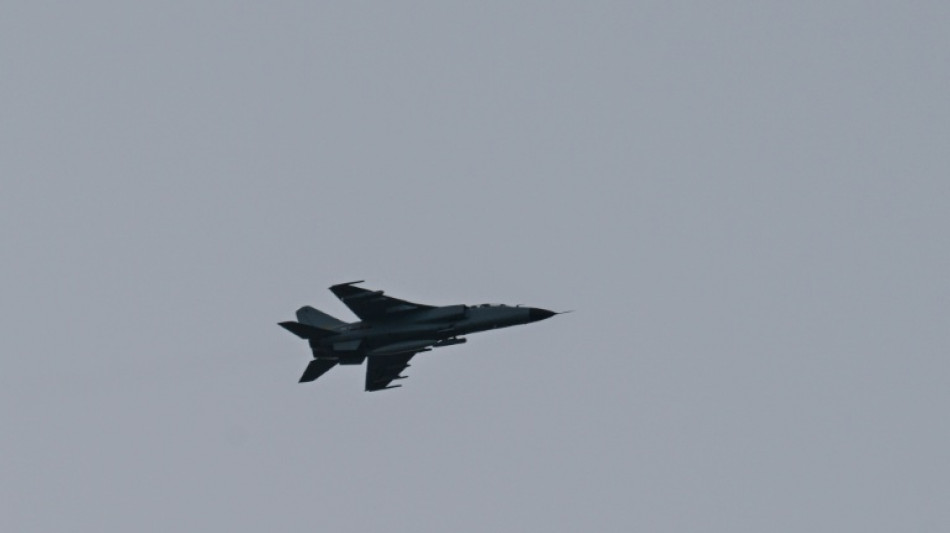
China widens military footprint with Laos air base / Photo: Hector RETAMAL - AFP
When China opened its first overseas air force base this week, a joint facility in isolated Laos, it was sending a signal -- its foreign military foothold is set to grow, analysts said.
Beijing has long sought to increase its influence across Asia-Pacific, competing with Washington and its allies over crucial shipping routes and undersea resource exploration, including in the disputed South China Sea.
Under leader Xi Jinping, the world's second-largest economy has sought to modernise its military, ramping up defence spending and pressure on Taiwan, which it claims.
Until now, installations abroad were primarily naval bases.
The Joint Flight Training and Support Centre in Laos is the "first air force base that China has abroad", said Joshua Kurlantzick, a Southeast Asia expert at the Council on Foreign Relations.
He told AFP that more will likely be established, in the region and in other nations friendly to China, as it experiments with how to run an air base beyond its borders.
China is "not building one base in Laos and stopping", he said.
The two communist nations said the centre at Ban Keun airfield, north of the Laotian capital Vientiane, was aimed at training Laotian air force pilots.
China's defence ministry added that the site would be "maintained for normal operations by both sides" and did not target any third party.
Security researcher Collin Koh said that China -- Laos's largest creditor -- was "trying to showcase that it is able to extend itself in defence diplomacy", at least with "amenable countries".
Training Laotian pilots will require China to put military assets there -- whether modest transport aircraft or modern fighter jets.
"From training then you have a (Chinese) military presence," Koh said.
- Chinese bases -
China only spends around a third of what the United States does on its military, according to the SIPRI Military Expenditure Database, and its foreign military footprint is dwarfed by the US, which has several hundred bases around the world.
China opened its first overseas base in 2017 in Djibouti, an east African nation strategically located near the Red Sea and Gulf of Aden.
The site has been expanded to include a sophisticated signals intelligence facility, which has prompted France and the US to consider moving their own bases in Djibouti to avoid Chinese intercepts, according to Kurlantzick.
China has also funded upgrades to the Ream naval base in Cambodia, a staunch ally, situated on the Gulf of Thailand.
Cambodian Prime Minister Hun Manet and a Chinese military delegation inaugurated a joint logistics and training centre there last year.
Washington says the base, which was originally built partly with US funding, could give Beijing a strategic position near the South China Sea.
Two Chinese anti-submarine corvettes have docked at its port for long stretches, although US and Japanese vessels have also made port calls since the base's revamp.
By contrast the Laos centre will likely be used exclusively by the Laotian and Chinese militaries, Koh said.
Ban Keun could be used as a "convenient stopover" for China's air force, and Chinese personnel may be stationed there, he added.
"We cannot discount the deployment of combat assets in the area in the name of training the Laotian air force."
Neither government has released details on the personnel or military hardware to be based at the site.
- 'Keeps China happy' -
The US and its regional partners, such as Vietnam and Thailand, will be watching closely for signs of military build-up.
The US defence department said last year Beijing had likely considered establishing military facilities in around 20 countries, mostly in Africa and Asia -- not including Laos.
Asia military specialist Carl Thayer warned against alarmism, noting that the Ban Keun site could only support light aircraft and military trainers for now.
And it was unclear whether any Chinese military presence in Laos would be permanent or well-equipped, he said.
"You have China's advancement," he added, but "it's not a crisis at the moment". "It's not Djibouti, it's not Ream, but it marks a change."
For underdeveloped Laos, the new joint facility offers military training and equipment, financial incentives and even stronger ties with Beijing, analysts say.
"The benefit for Laos is it keeps China happy," Kurlantzick said.
A.Ortiz--GBA