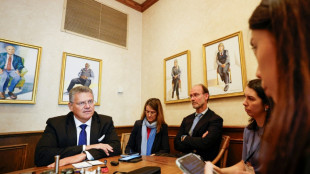
Ticking time bomb? Europe's ageing population brings challenges / Photo: John MACDOUGALL - AFP
The population of the 27-nation European Union will peak in 2029 before falling in the coming decades, according to a report published Tuesday that spotlights the major challenges the bloc faces from an ageing population.
Today there are 450.6 million people, but researchers say this will peak at 453.3 million in 2029 before a slow long-term decline.
The population will fall to 398.8 million people by 2100, an overall drop of 11.7 percent and a level that was last experienced in the 1970s.
Europeans are living longer than ever before thanks to vastly improved healthcare, and better life and social conditions.
But an ageing population poses challenges for society and the EU economy, and while migration could help, it's not the fix Europe might hope for.
The EU executive's Joint Research Centre said life expectancy at birth reached 81.5 years in 2024.
By 2050, nearly one in three EU residents will be aged 65 or older, compared to one in five today, the centre said.
By 2100, life expectancy could exceed 90 years for women and 86 for men.
Such trends present "significant challenges", the EU said, including labour shortages, strained public budgets, and pressure on care and education systems.
It is, however, not all negative as the report points to the rise of the "silver economy" -- a growing market for goods and services for older citizens.
- 'Migration is a necessity' -
Migration can help offset some effects of Europe's demographic change, the researchers said, but it would have a limited impact on "fully" addressing the challenges posed by an ageing population.
But as fertility rates fall, migration counterbalances the negative effects of an ageing population and labour force contraction, the report said.
"Migration is a necessity," EU commissioner Dubravka Suica told reporters.
Fewer babies are being born to each woman in Europe, a decline that has been steady since the 1960s.
The fertility rate fell to 1.34 children per woman in 2024, well below the replacement level of 2.1 needed to keep the population stable without migration.
The median age of a European was 44.9 in 2025, and there are major disparities between EU countries. Ireland is relatively young with a median age of 39.6 years while Italy's was 49.1.
"We are living longer, healthier lives than ever before –- one of our greatest achievements. But demographic change is reshaping our societies, our economies and our labour markets," Suica said in a statement.
"We must act now to turn this transformation into an opportunity," she added.
The EU insists the bloc must boost productivity and cut unemployment to offset the effects of a shrinking workforce.
Currently around 20 percent of working-age Europeans are outside the labour force, the report said, while some eight million young people are neither in employment, education nor training.
The situation is particular to Europe as the global population is not falling.
Population growth is increasingly concentrated in parts of Sub-Saharan Africa, South Asia and some Middle Eastern countries, the report said.
A.Castillo--GBA