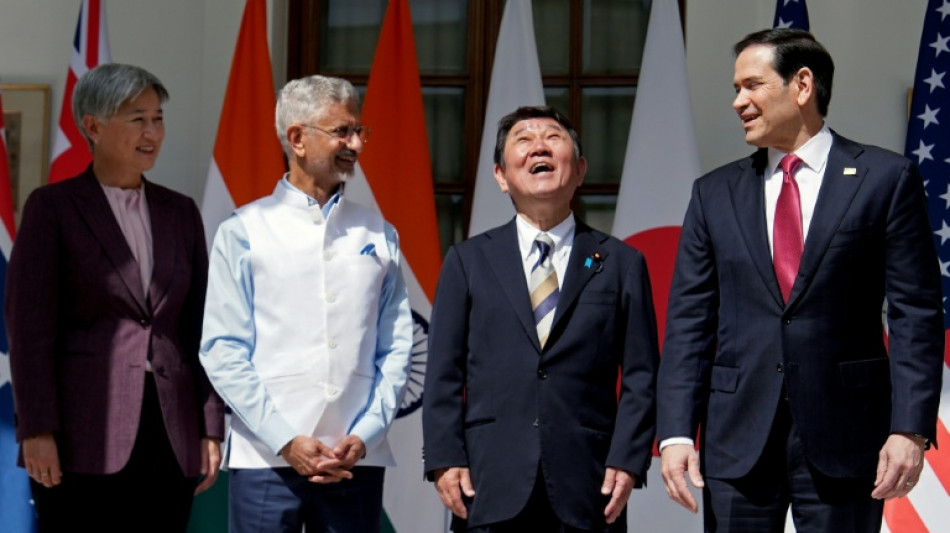
Rubio revives 'Quad' with new Asia projects after questions on US / Photo: Julia Demaree Nikhinson - POOL/AFP
The United States, India, Australia and Japan announced new maritime and critical minerals cooperation on Tuesday, reviving a forum viewed suspiciously by China following questions over the US commitment and disagreement on Iran.
US Secretary of State Marco Rubio took part in the meeting in New Delhi, 10 days after President Donald Trump paid a friendly state visit to China and spoke glowingly of the two powers working together as a "G2" -- a concept that the US allies, which view Beijing's rise warily, fear could shut them out.
Meeting his counterparts, Rubio said the Quad comprised countries "who share strong values -- strong, vibrant democracies -- who also are committed to many of the same concepts with regards to economic development and have many aligned interests".
Rubio said the four powers would work together on two maritime initiatives -- one that combines their surveillance capabilities, and another that will provide enhanced real-time information to commercial traffic at sea.
In a first, Australian Foreign Minister Penny Wong said the Quad was cooperating on assisting port development in Fiji -- a key island nation in the South Pacific, where China has made a concerted push for greater influence.
Rubio said the Quad would also step up four-way efforts to secure the supply of critical minerals, a rare area in which the Trump administration has turned to the more traditional diplomacy of building networks with allies, alarmed at the dominance of China in resources key to the high-end technology sector.
Trump, since taking office, has repeatedly been dismissive of major allies, saying they unfairly burden the United States financially.
While Rubio held two Quad meetings last year, including hours after taking office, Trump declined to commit to a four-way leaders' summit.
It marked a strong contrast to his predecessor Joe Biden, who put a top priority on alliances and vowed that Quad summits were "here to stay".
Rubio said the Trump administration wanted the Quad to focus more on deliverables than meetings, and said cooperation was progressing "pretty aggressively".
- Disagreement on Iran -
Freedom of navigation has long been Washington's codeword for opposing China's assertiveness at sea, a particular concern for Japan.
But the United States has recently pointed to the principle as it tries to rally allies to counter Iran, which has exerted control over the strategic Strait of Hormuz in response to a US-Israeli war launched on February 28, sending global oil prices spiralling.
No US ally other than Israel has robustly supported the decision to attack Iran, enraging Trump, who has questioned the reliability of US partners, whom he had not consulted beforehand.
India's Foreign Minister Subrahmanyam Jaishankar said the focus of the talks would be "the Indo-Pacific, which is the specific limit of the Quad".
Besides Iran, India has differed with the other Quad nations on Russia's invasion of Ukraine by refusing to sever its long-standing relationship with Moscow.
Australia's Wong said there was much to focus on in Asia, due to its "deteriorating strategic environment and acute economic stress".
Australian Prime Minister Anthony Albanese is one of the few world leaders who has voiced some understanding for the Iran war, citing concerns about its disputed nuclear programme, but he has not assisted the war effort and Trump said he was "not happy with Australia".
Japan and India both historically have maintained cordial relations with Iran, although they grudgingly complied with US sanctions aimed at stopping all other countries from buying Iranian oil.
Japanese Foreign Minister Toshimitsu Motegi, holding a bilateral meeting with India on Monday, said it was important to address an "increasingly severe" global security situation.
"The world is faced with the most significant structural change in the post-World War II era, driven by a shift in the balance of power and the intensification of conflict and confrontation," Motegi said.
A.Ortiz--GBA