Israel strikes 'decimated' Iran as war roils markets / Photo: Ronen Zvulun - POOL/AFP
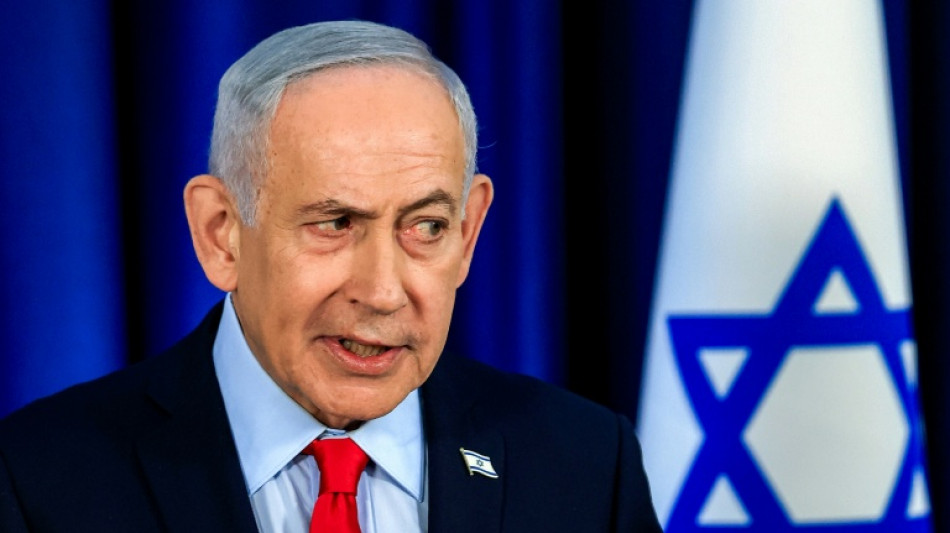
Israel launched a new wave of strikes on Tehran on Friday after Prime Minister Benjamin Netanyahu said Iran was being "decimated", and as Gulf nations faced a fresh set of attacks.
The Iranian capital, under near daily bombardment since a joint US-Israeli attack started the war on February 28, was hit by strikes the Israeli military said were "targeting infrastructure of the Iranian terror regime".
The bombardment came shortly after Netanyahu said the Middle East war had eradicated the Islamic republic's capacity to enrich uranium or manufacture ballistic missiles as the conflict heads towards a fourth week.
"We are winning and Iran is being decimated," the Israeli premier said at a press conference.
But Iran has kept up retaliatory fire on Israel and Gulf nations, including attacks on oil and gas facilities that have exacerbated concerns of a global energy supply shock.
Several blasts were heard over Jerusalem on Thursday night as Israel's military said it had identified three rounds of Iranian missile fire, with no reports of casualties.
The United Arab Emirates and Kuwait reported missile attacks, while Saudi Arabia intercepted more than a dozen drones early Friday as Gulf nations began the observation of Eid al-Fitr, the holiday that marks the end of the Islamic fasting month of Ramadan.
The war, which has killed hundreds and displaced thousands, has quickly spread to Lebanon where the Israeli military has carried out regular bombardments in response to rocket fire on Israel by Iran ally Hezbollah.
Lebanon's health ministry said the death toll from Israeli airstrikes on southern and eastern Lebanon as well as on the capital Beirut and its southern suburbs has surpassed 1,000.
Lebanese President Joseph Aoun, during a meeting with French Foreign Minister Jean-Noel Barrot on Thursday, renewed a call for a truce between Israel and Hezbollah and the opening of negotiations that France's president later said depended on Israel agreeing to join.
Israeli premier Netanyahu, enjoying rising popularity at home from a conflict that has drawn attention away from the Gaza war, said Israel was "winning" against Iran.
"I also see this war ending a lot faster than people think," he said, without providing a specific timeframe.
- 'Cracks' in Iran -
Netanyahu said Israel saw "cracks" in the Iranian leadership and was trying to exploit them.
"Mojtaba, the replacement ayatollah, has not shown his face," he said, in a reference to Iran's newly appointed supreme leader, the son of Ayatollah Ali Khamenei who was killed in an Israeli airstrike on the first day of the war.
Tehran has stepped up attacks on Gulf nations' energy infrastructure in recent days, spooking markets and raising alarm that inflation would surge globally.
Energy markets were left reeling after Iranian missiles hit Qatar's huge Ras Laffan natural gas complex in retaliation for Israel's air raid on the South Pars gas field this week.
Iran responded that it would have "zero restraint" if its energy infrastructure was hit again, having already choked the Strait of Hormuz, the crucial channel for around a fifth of the world's crude oil and liquefied natural gas during peacetime.
The latest attack on Ras Laffan caused "extensive damage" that Qatar's state energy company said could cost $20 billion a year in lost revenue and take five years to repair.
Fears of energy supply shortages have sent gas prices surging and oil prices sitting around $100 a barrel.
There was slight optimism on Friday as crude prices eased during early Asia trading in response to Netanyahu's remarks suggesting that the war would end earlier than many feared.
But attacks continued on the Gulf, where Iran's Revolutionary Guards said in a statement Friday they had targeted US forces at the UAE's Al-Dhafra air base.
Drone attacks sparked a fire at Kuwait's Mina Al-Ahmadi oil refinery, state media reported, adding several refinery units were shut down as firefighters worked to contain the blaze.
Many around the region ended the holy month of Ramadan on a bitter note, unsettled by the war and facing rising prices.
"There's nothing to celebrate," said Aziza Ahmad, who has cancelled her family's normal plans for a festive meal and gifts for the children, her small Beirut apartment hosting several displaced relatives.
"Maybe it's different for the rich, but the joy of Eid is missing here... We have no money, and the displaced people can't even go back home," she said.
Iranians were marking the new year spring festival of Nowruz on Friday, as well as the final day of Ramadan, with state media reporting Iran would observe the Eid holiday on Saturday.
- No timeframe -
Trump indicated he did not know in advance about Israel's raid on South Pars, which supplies about 70 percent of Iran's domestic needs.
"We get along great. It's coordinated, but on occasion, he'll do something" that Washington opposes, Trump said.
Netanyahu said Israel acted alone with the strike and it would respect Trump's request to hold off on future attacks on the gas field.
Trump warned that the United States would "blow up" South Pars if Tehran did not stop attacking Qatar but he said there was no current plan to send ground troops into Iran.
Netanyahu indicated that changing the government in Tehran would require "a ground component", without elaborating.
"There are many possibilities for this ground component and I take the liberty of not sharing (those) with you," he said.
As concerns grow over the conflict's economic fallout, President Emmanuel Macron said France planned to talk with permanent members of the UN Security Council about establishing a framework to secure navigation in the Strait of Hormuz -- but only after fighting had stopped.
Pentagon chief Pete Hegseth said there was no clear end in sight for the war.
"We wouldn't want to set a definitive timeframe," he told reporters.
"It will be at the president's choosing, ultimately, where we say, 'Hey, we've achieved what we need to.'"
burs-jfx/ceg/ami
P.Aguilar--GBA