Blowing in the wind, humble balloon gets green makeover / Photo: HENRY NICHOLLS - AFP
A global symbol of parties and celebrations but an environmental headache, the humble balloon is undergoing a green revolution thanks to UK researchers.
Researchers at Imperial College London say they have developed the first fully biodegradable balloon and hope to bring it to market within two years.
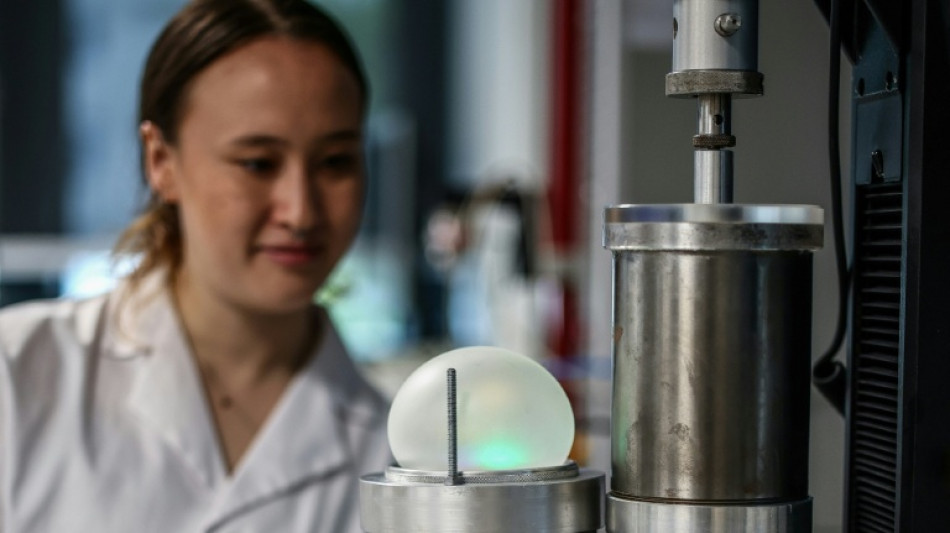
"So there was hundreds of trials. We had many, many failures," said Juliana Cumming, a PhD student at the university and co-creator of the "Bioloon", a 100-percent biodegradable balloon.
In a university laboratory, the 29-year-old proudly showed AFP a flask containing a precious yellow liquid.
Once solidified, it becomes a soft, elastic material with a texture comparable to that of a conventional balloon.
But there is one crucial difference -- it breaks down completely within nine months unlike traditional balloons, Cumming said.
The Bioloon is the result of a public-private partnership launched by Charlotte Melia, an events entrepreneur, who describes herself as environmentally minded.
"I was a party planner for over 10 years and ... I was very sustainably focused. The final stumbling block for me was the balloon waste," she told AFP.
"We were putting out thousands of party balloons every single week," she said, but they were only there "for a matter of hours simply to be popped and thrown in the trash".
The final straw came when she realised "balloons were non-biodegradable" even though the packaging said they would say break up "at the rate of an oak leaf".
Convinced that a sustainable alternative was possible, Melia decided with an associate to put up some £30,000 ($41,000) to part fund Cumming's doctoral research.
- Ecological risk -
The environmental impact of traditional balloons, which despite their advertising do not degrade, is largely unknown to the general public.
But a number of studies have documented the dangers posed by balloons once they end up in nature, particularly for marine life and birds.
A 2019 study by the University of Tasmania, published in Scientific Reports, found balloons were "the highest-risk plastic debris item" for seabirds, carrying a mortality risk 32 times higher than ingesting hard plastics.
Imperial College's department of chemical engineering estimates that between 20 and 25 billion balloons are purchased worldwide every year.
Cumming spent three years developing her formula.
The starting point is the same as for an ordinary balloon: natural latex derived from the sap of the rubber tree, native to the Amazon, and has changed little since the balloon was invented in 1824.
"In order to turn the natural latex into something that we refer to as rubber it goes through this process called sulphur vulcanisation," she explained.
That involves adding "sulphur accelerators, antioxidants, and activators into the material" which "prevents the biodegradation of balloons" and also leaks "toxic chemicals into the environment".
- Gloves, condoms and clothing -
It was this stage of the manufacturing process which became the focus of Cumming's research. "Our balloon is still made with natural latex, but we blend it with another biodegradable polymer and we don't add any of these additives that are used in traditional balloons," she said.
"So this retains the biodegradability," she added, declining to reveal further details of the patented process.
According to the creators, the Bioloon breaks down regardless of where it ends up.
The researchers "tested it in soil, seawater and deionised water. It degraded in all of those conditions ... and we estimate that it would biodegrade within about nine months," she said.
Importantly for all those planning a shindig, the balloon inflates as easily as a conventional one.
For Melia, the technology's potential extends far beyond party decorations, and could be adapted for everyday and medical products, including household gloves, surgical gloves, latex clothing and condoms.
P.Venegas--GBA