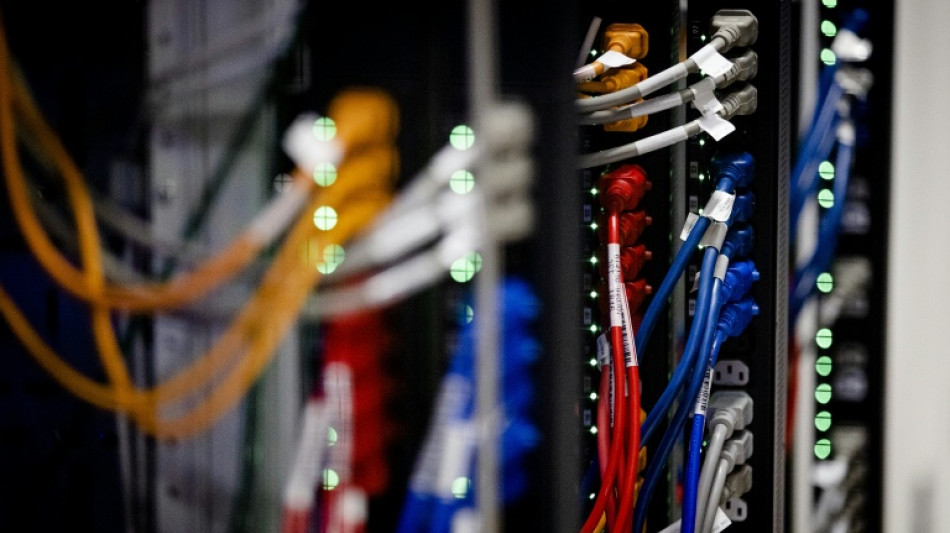
EU proposes energy rating for data centres / Photo: Sem van der Wal - ANP/AFP/File
Data centres in Europe will be rated on energy and water consumption under an EU proposal put forward Monday to pre-empt possible public discontent as the bloc pushes to boost its computing capacity.
The European Union is aiming to triple its data centre capacity over the next seven years as it plays catch up with the United States and China on artificial intelligence.
"Tripling our data centre capacity cannot mean tripling the pressure on our grids, our water and our energy bills," said European Commission vice president for clean transition Teresa Ribera.
Data centre construction has sparked backlash across the United States, with local residents often complaining about the power-hungry engines of AI driving up electricity costs -- a hot political issue ahead of November's midterm elections.
The EU said its scheme would provide the public with information about the water and energy consumption of sites with capacity above 500 kW, which already have to report key performance metrics to the EU.
Similarly to that already in use for home appliances, the rating will rank data centres on a coloured scale where A/Green is the most efficient and G/red the least efficient, according to a commission presentation.
To encourage good practices, the score will take into account data centres' contribution to the grid, such as the reuse of waste heat and the addition of clean energy generation capacities, the commission said.
"Efficient, flexible, powered by additional clean energy and reusing waste heat, this is how data centres become an asset for (the) EU's energy transition," Ribera added.
Data centres are yet to become a flashpoint political issue in the 27-nation EU, as the bloc lags well behind the United States on AI development.
The slower growth is in part due to already-high-energy costs, which weigh on European businesses and families alike.
But the International Energy Agency estimates the fast expanding sector will account for more than three percent of overall electricity demand in the EU by 2030.
"To ensure that the digital transformation truly works for our society, we must address the growing energy demand of data centres," said the EU's energy commissioner Dan Jorgensen.
"Understanding their energy and resource consumption is the essential first step towards integrating them sustainably into our energy system."
The labels will be automatically generated by the EU based on companies' reporting and will be accessible on an EU database, with the first expected to appear in 2027, Brussels said.
The commission said it was also looking into setting minimum performance standards for data centres.
Q.Romano--GBA