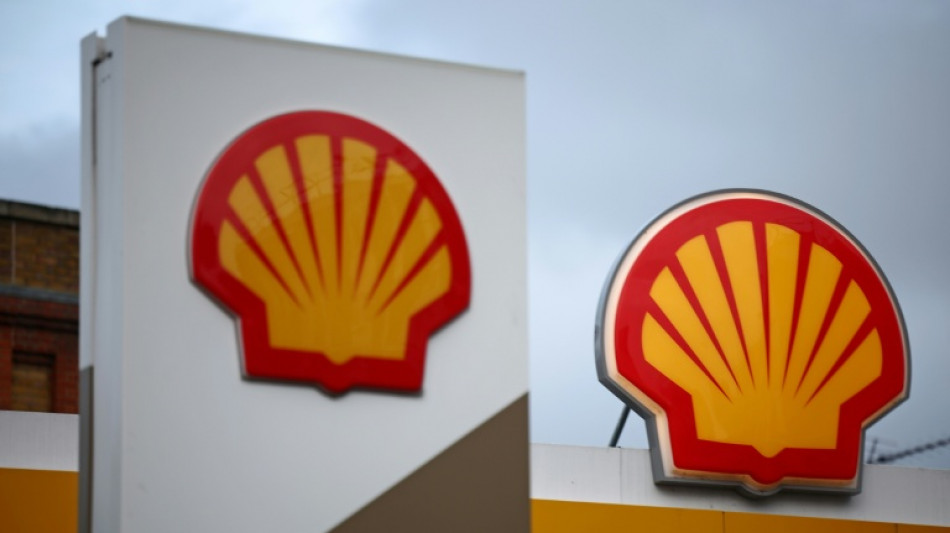
Shell profit jumps as Mideast war fuels oil prices / Photo: HENRY NICHOLLS - AFP
British energy giant Shell announced Thursday rising net profits for the first quarter as the Middle East war sent oil and gas prices soaring in volatile trading.
Profit after tax increased 19 percent to $5.69 billion in the January-March period from $4.78 billion in the first quarter of 2025, Shell said in an earnings statement.
"Shell delivered strong results enabled by our relentless focus on operational performance in a quarter marked by unprecedented disruption in global energy markets," said chief executive Wael Sawan.
In addition to benefiting from soaring prices at the pump caused by the Iran war that began on February 28, energy majors have profited from their trades as oil and gas futures swung between big gains and losses on the war's latest headlines.
Shell's total revenue was stable at around $70 billion in the first quarter year-on-year but rose from $66.7 billion in the fourth quarter of 2025.
- Shutdowns -
Oil prices jumped during the quarter from around $72 a barrel on the conflict's eve to more than $100 a barrel at times in March as Iran's almost complete shutdown of the key Strait of Hormuz roiled global markets.
Shell's gas production was meanwhile impacted after the world's largest liquefied natural gas hub, Ras Laffan in northern Qatar, suffered significant damage in the war.
Shell highlighted further fallout in the current second quarter.
The group last week announced it would acquire Canadian company ARC Resources in a $16.4-billion purchase to boost its access to shale gas and liquids production.
"The ongoing conflict in the Middle East has resulted in production shutdowns and export constraints," Shell said in its earnings release.
"Since the start of the conflict, commodity prices and refining margins have been highly volatile," it added.
Alongside the results, Shell boosted its shareholders by announcing it would repurchase $3 billion worth of its shares as well as hiking its dividend.
However, "the company is slowing the pace of quarterly buybacks from $3.5 billion", noted Susannah Streeter, chief investment strategist at Wealth Club.
"It's a sign that more caution is creeping in and that management is still keeping an eye on how the conflict will unfold rather than aggressively expanding returns to shareholders."
Shell's share price dropped 2.3 percent on London's FTSE 100 index, which reflected also further easing of oil prices on hopes of an end to the Iran war.
Some of Shell's rivals have also enjoyed sizeable profits thanks to the conflict, with BP last week reporting that its first-quarter net earnings had soared to $3.8 billion.
French oil and gas giant TotalEnergies reported a 51-percent jump to $5.8 billion for the January-March period.
"Fossil fuel giants are pocketing monstrous profits while drivers are being squeezed at the petrol pump and households are set to pay higher energy bills," Danny Gross, climate campaigner at Friends of the Earth, said Thursday.
Ch.Luna--GBA